By The Sleep Diva
Over the last two installments, I’ve walked through how mattress flammability regulation evolved over my 25 years in this business, where the chemical shortcut actually came from, and why the federal cigarette test is still built around a fire risk that’s largely disappeared. This time: the fight over California’s actual ban, and the full toll — on the people sleeping on these chemicals, the firefighters who respond when they burn, and the environment they end up in.
California Shows How the Fight Actually Went
It’s worth being precise here, because two different California laws get conflated in this conversation, and the difference tells you a lot about how hard this was to change even once the evidence was in.
Proposition 65, passed by voters in 1986, was never designed to ban anything. It’s a general right-to-know statute: if a product exposes Californians to any of roughly 900 listed carcinogens or reproductive toxins, the seller has to warn them. Several flame retardants — TDCPP and TBBPA among them — were added to that list over the years, which is why warning tags started showing up on mattresses and furniture. But a Prop 65 listing was only ever built to produce a label, not a prohibition.
The law that actually banned flame retardants outright — AB 2998, signed in 2018, effective January 2020 — is a different, much more recent story, and it shows exactly how much resistance stood between the science and the shelf. The three dominant flame-retardant manufacturers, Albemarle, Chemtura, and ICL, successfully lobbied California’s legislature for 38 years to keep the old open-flame furniture standard in place, spending over $20 million in a single year at one point defending it. When AB 2998 finally reached its last legislative hours, a coalition led by the American Chemistry Council was still sending letters urging lawmakers to vote no, arguing that banning the chemicals would “arguably increase fire risk” — the same argument the industry had been making, with CPSC’s own testing quietly contradicting it, for a decade.
Even the mattress industry’s own trade group, the International Sleep Products Association, got involved to soften the bill. It “aggressively opposed” AB 2998, and lobbied successfully to narrow its scope: the ban that finally passed covers only flame retardant chemicals added to mattress foam, and specifically excludes the fire barrier fabrics used in mattresses. So the one law that actually prohibits these chemicals still carries an industry-negotiated exception for the mattress industry itself.
Even the UK’s Own Reviewers Aren’t Convinced
Since Crib 5 is the toughest test in the world, it’s worth asking directly: does the UK actually get more for it? I went looking, and the honest answer complicates the “toughest standard, safest outcome” story the industry likes to tell.
At face value, the UK’s numbers look like a clear win. Furniture-fire fatalities roughly halved after the 1988 Furniture and Furnishings (Fire) Safety Regulations took effect — from about 1 death per 20 households before the rules to 1 per 40 by 2006. An industry-commissioned analysis credited the regulations with 54 fewer deaths a year.
But New Zealand saw the same decline over the same decades with no furniture flammability regulation at all. So did other European countries with far weaker standards. The more obvious explanation is sitting in plain sight: smoke alarm ownership in England and Wales rose from 8% in 1988 to 95% by 2017, and smoking rates nearly halved over the same span — both changes that would drive a fatality decline with or without a flammability rule. A formal UK government review of English fire fatalities concluded there is a lack of evidence that the 1988 regulations helped reduce fire deaths, even as the actual death count fell from a peak of 755 in 1981 to 252 roughly four decades later. The regulations are currently under government review for exactly this reason, and one of the specific concerns raised is that children’s products in scope of the review still rely on flame retardant chemicals despite the open questions about whether any of it is doing what it claims.
And here’s the part that matters for who gets to tell this story: I recently came across a website praising the UK standard as a model of fire safety, complete with polished video content. It’s run by the North American Flame Retardant Alliance — a project of the American Chemistry Council whose current members are named, specifically, as Albemarle, Great Lakes Solutions (formerly Chemtura), and ICL. The same three companies that founded Citizens for Fire Safety in 2007. The same three companies that shut it down after the Tribune exposé in 2012 and moved their advocacy to NAFRA. Eighteen years, three names, one message, and the UK’s own reviewers aren’t buying it.
What the Chemicals Actually Cost
When people ask about the cost of these regulations, they usually mean the price tag on the mattress — CPSC itself estimated the open-flame rule would add roughly $23 to manufacturing and $24 to the retail price. That’s the smallest number in this story.
The chemicals used to meet these standards — PBDEs, TDCPP, antimony trioxide, TBBPA, and others — don’t bond to the foam they’re added to. They shed. They collect in household dust, get inhaled and ingested, and accumulate in the body over years, because most of them don’t break down. The National Institute of Environmental Health Sciences links this class of chemicals to endocrine and thyroid disruption, immune and reproductive toxicity, cancer, and developmental harm in children — who tend to carry higher body burdens than adults simply because they’re on the floor more and put their hands in their mouths more.
Firefighters carry the worst of it. Firefighting is classified by the International Agency for Research on Cancer as possibly carcinogenic, and firefighters face roughly 9% higher odds of a cancer diagnosis and 14% higher odds of dying from cancer than the general public — with esophageal cancer rates 62% above the general population, according to the Marine & Environmental Research Institute.
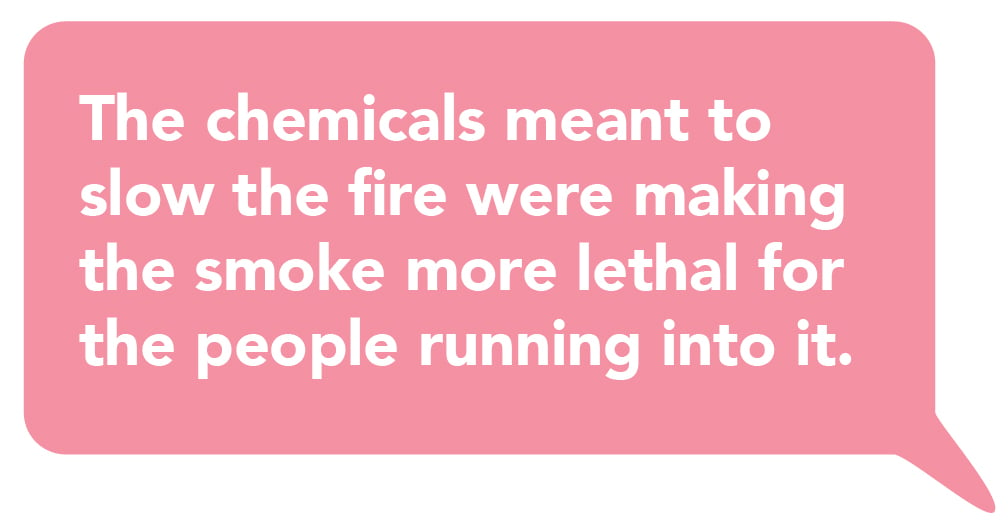
That’s not only from the fire itself. It’s from what’s released when flame-retardant-treated materials burn: research out of the UK found that flame-retarded upholstery burned only marginally slower than untreated material, while producing significantly more carbon monoxide and hydrogen cyanide in the process. The chemicals meant to slow the fire were making the smoke more lethal for the people running into it.
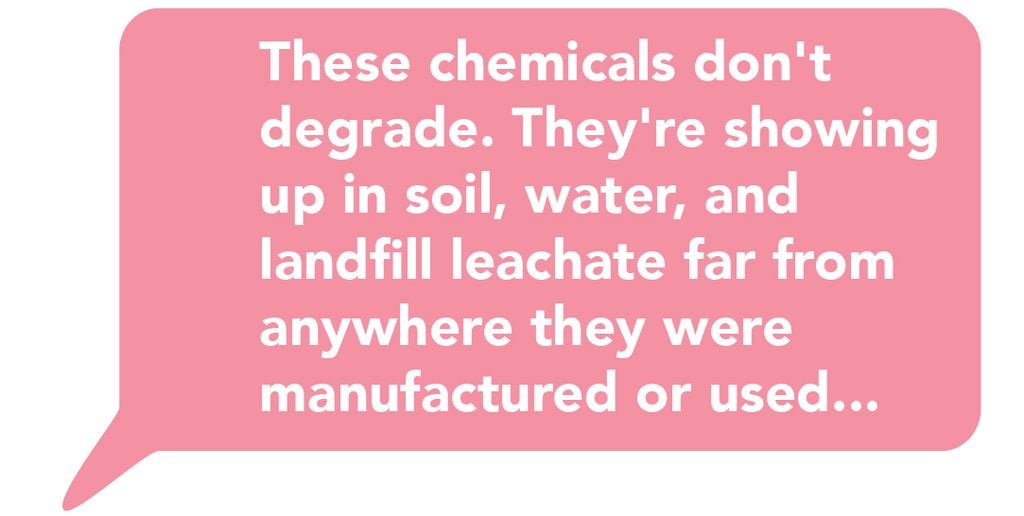
And then there’s what happens after the mattress or sofa is gone. These chemicals don’t degrade. They’re showing up in soil, water, and landfill leachate far from anywhere they were manufactured or used, decades after some of the worst offenders — like PBDEs — were supposedly phased out.
A Different Way Was Always Available, But Why Do We Need It?
What frustrates me most, twenty-five years into this business, is that none of it was necessary. We proved that in 2000 with cotton and wool. We proved it again in 2007 with felted wool and a fitted cover. We proved it a third time in 2013 with graphite in latex, on the hardest test in the world. California eventually proved it too — its 2013 revision to TB117 quietly dropped the open-flame requirement for furniture filling, and the industry itself acknowledged that meant flame retardant chemicals were no longer necessary to pass. California banned most of them outright in 2020.
So the tests can be met without loading a mattress with chemicals. The question the industry has never had to answer in public is why so much of it chose the chemical shortcut anyway — and why the regulations that made that shortcut so attractive were shaped, at the root, by an industry that had nothing to do with sleep at all. And finally, why are we one of only 2 countries in the world that requires our mattresses to be flame retardant in the first place?