Notes From The Road with Chris Taheny
When I asked retailers in an industry Facebook group when they decorate their stores for Christmas, the consensus was Black Friday weekend. I understand the sentiment. One holiday at a time, people! Let the turkey have its rightful moment on the calendar, finish the pumpkin pie, and then untangle the Christmas lights. But your personal decorating preferences and your retail marketing calendar deserve separate consideration. While you were waiting to put up the tree and decorate your stores, major retailers were already helping your customers choose gifts, plan purchases and commit their holiday budgets to them.
This year’s calendars make the point. Target and Kohl’s were promoting early holiday shopping in the first week of October, and Walmart was publicly outlining holiday shopping conveniences by October 7. These businesses were giving customers reasons to browse and buy well before Thanksgiving. If your store waits until Black Friday to enter the conversation, you’re arriving after other retailers have spent weeks making the hay.
Let’s Put a Number on the Head Start
Here’s a simple calculation: Your holiday messaging start date − November 1 = days surrendered. Start November 10, and you’ve surrendered nine days. Start November 15, and it’s 14. If you waited until Black Friday this year, you gave away 26 days. That’s nearly four weeks for other retailers to introduce gifts, fill wish lists and become the destination a customer already has in mind for everything from cookware to streaming sticks to bananas. Meanwhile, your sheets, pillows, throws and guest-room essentials may be waiting patiently for someone to remember you sell them.
November 1 is a practical benchmark, not the starting gun for the entire retail industry. As the October promotions demonstrate, some competitors were already running laps by then. The formula doesn’t calculate lost revenue or prove that every early promotion produces a sale. It measures how much of November passed before you gave customers a visible holiday reason to consider your business.

They’re Already Bigger Than You. Why Help Them Out?
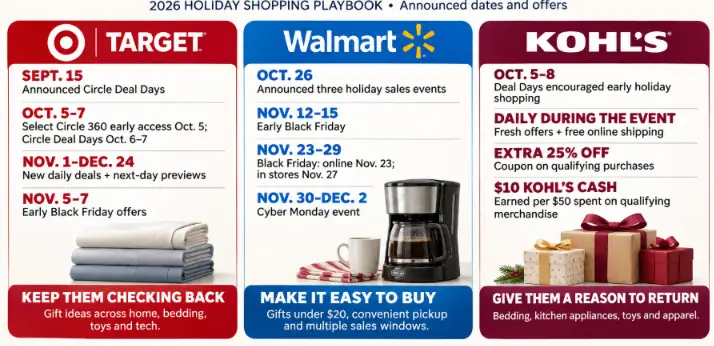
So what were the big boys of retail up to this year? Target announced its 2026 Circle Deal Days way back on September 15, with the event running October 6–7 and select early access beginning October 5 for Circle 360 members. Its promotion explicitly connected fall shopping with early holiday gifting, spanning home products, kitchen gadgets, toys, technology and seasonal décor. Bedding was part of that conversation, too, with advertised savings on Hearth & Hand with Magnolia bedding and bath products. Target then scheduled daily deals from November 1 through December 24 and Early Black Friday offers for November 5–7.
The lesson for an independent retailer is the sequence: introduce seasonal needs early, offer specific reasons to shop, and keep giving customers something new to consider. Oh, and KEEP THEM TUNING IN for tomorrow’s deal reveal. You don’t need Target’s budget to feature guest-room pillows one week, giftable throws the next and premium sheets after that. You need an assortment worth talking about and a calendar that keeps you talking about it.
Kohl’s is also embedded into the holiday shopper’s brain, so what were they up to this year? They held a Deal Days event October 5–8, explicitly inviting customers to begin holiday shopping. The event combined category discounts, an additional coupon on qualifying purchases, free shipping on online orders and new daily offers. Home merchandise (including bedding) was part of the promotion, alongside kitchen appliances, toys and apparel. Customers could also earn $10 in Kohl’s Cash for every $50 spent on qualifying merchandise, creating an incentive for another shopping visit. Already, we see the pattern they’re capitalizing upon that our industry has room for improvement in: GIVE THEM A REASON TO COME BACK.
And then there’s Walmart. By October 7, Walmart was presenting its holiday shopping plans around convenience, including Express Pickup that could have an order ready in as little as an hour at participating stores. On October 26, it announced a sequence of holiday sales: Early Black Friday deals November 12–15, online Black Friday deals beginning November 23 and Cyber Monday offers beginning November 30. Its holiday merchandising also highlighted gifts under $20 and a curated toy list with 25 selections under $25, helping shoppers identify options within a budget.
Walk into any of these locations on November 1, and you saw blinking lights and heard Mariah singing “All I Want for Christmas is You“. The messaging for the consumer is clear: ready or not, the holiday season is here!
The Money Can Be Spoken For Before It’s Spent
Picture a customer with $100 budgeted for her parents. After work, she heads to Target for coffee, milk and bananas, with plans to browse gift ideas she saw in her Facebook feed. A pair of pillows might be perfect for Mom and Dad. So might fresh sheets or something comfortable for their guest room. But she spots a coffee maker, checks the price and texts her brother, “I’ve got Mom and Dad covered.” She hasn’t bought it yet and may be waiting for a sale, but that portion of her holiday budget now has a destination.
Your store can still compete for that purchase, but you’re asking her to reconsider a plan instead of helping her create one. The opportunity begins when the customer is deciding what would make a good gift, not only when she’s ready to pay. By the time you announce your holiday sale, her shopping list may already be largely settled.
Your Competition Has Coffee Makers
Mattress retailers naturally watch the mattress store across town, but holiday gift budgets travel across categories. Your pillows compete with headphones, your sheets compete with sweaters, and your throws compete with candles, appliances and gift cards. This is precisely the time of year that a customer doesn’t have to purchase your direct competitor’s bedding for you to miss the opportunity. She only has to choose something else before she understands what your store offers.
Put a Gift Guide on Your Website
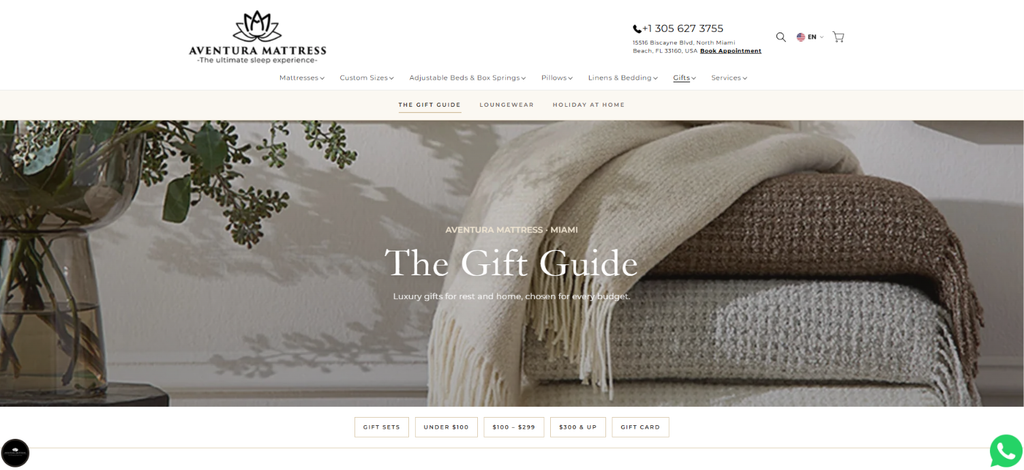
If you sell giftable products, publish a holiday gift guide on your website. Help shoppers browse the way they think: gifts for her, gifts for him, gifts for parents, gifts for the kids; selections under $25, $50, $100 or $200 where your assortment supports those prices; and bundles for guest rooms or cozy evenings at home. A throw becomes more interesting when it’s presented as “For the sister who’s always cold.” Premium sheets become easier to justify as “For the parents who would never splurge on themselves.” Give shoppers help choosing, rather than expecting a product catalog to do all the work.
No, this subpage won’t 2x-grow your sales. What it can do is help you capture more customers and tap into the lifetime values of the customers you’ve already done business with. Feature the guide on your homepage, link to it in emails and create social posts around individual gifts. Your gift guide should be ready when customers start making lists, not when your team finally finds a spare afternoon.
Our business has long embraced a golden sales rule: ask for the sale. This is exactly what this is.
Give Thanksgiving Its Own Reason to Shop
Before customers worry about wrapping gifts, many are figuring out where everyone will sleep. Ask, “Who’s sleeping at your house this Thanksgiving?” Then follow with, “When was the last time you spent a night in the bed you’re giving your guests?” That question gives your mattress floor a timely purpose and can lead naturally to sheets, pillows, protectors or a guest-bed upgrade. Build a display around those needs, with clearly priced options that fit your assortment and protect your margins.
There’s room for humor, too. A “Leaving So Soon?” Bedding Bundle could include two fresh pillows and a premium sheet set for $199. The social caption practically writes itself: “Make them comfortable. We can’t promise they’ll leave on time.” Give people something to smile about, then show them exactly what’s included and how to buy it. The joke earns attention; the useful offer gives that attention somewhere to go.
Calculate Your Number, and Take Those Days Back!
For next year, work backward from a November 1 launch. During October, choose your gift assortment, build a website gift guide organized by price and recipient, prepare a guest-room bedding offer, and schedule emails and social posts. Start with customers who already know you, offering useful reminders about sheets that fit their beds or pillows they might not have ever purchased themselves. Then keep those ideas visible throughout November, with clear offers, shopping links and invitations to stop in for bedding…even when they don’t need a mattress.
Every useful suggestion gives your store another opportunity to earn a visit, reconnect with a previous buyer and capture business beyond the next mattress replacement that no mattress retailer is ever guaranteed. You don’t need a big retailer’s advertising budget to join the holiday conversation, but you do need to show up while shoppers are still making their choices.
Give your customers reasons to shop before they’ve given their gift budgets to somebody else!