It was 1989 and I was a young college student who had just landed an entry-level position in the marketing department at Wells Fargo Bank headquarters in San Francisco. The early years of massive mergers and acquisitions were just beginning for America’s largest banks. New waves of deregulation had opened the door to interstate banking, and our little marketing department was suddenly very busy supporting a national sales team now free to sell banking products and services across state lines rather than just within California. As Wells Fargo acquired more banks, we produced maps to help customers find their new ATM and branch locations. I met my future husband during this time — he owned a printing company — and he printed all those maps, the 401K packets, the posters, everything. It was a boom time for banks and printers alike, and it kept us both very busy for several years.
THE BEGINNING OF A TRANSFORMATION
What neither of us fully appreciated then was that we were watching the beginning of a transformation that would ultimately leave American banking consumers with less choice, higher fees, and almost no neighborhood banks to speak of. The number of insured commercial banks fell from roughly 12,000 in 1990 to around 9,000 by the end of the decade, with the top 10 banks controlling approximately 50% of total industry assets — up from just 20% a decade earlier. By 2008, those banks had ballooned into mega-institutions, no longer contained within state lines, no longer accountable to local communities, and — as we all discovered — too big to fail. The subprime mortgage collapse didn’t just hurt Wall Street. It hurt everyone downstream.
The mattress industry is not a bank. But the pattern is familiar. And those of us who have been in this industry long enough are watching it repeat.
WHERE WE CAME FROM
To understand what is being lost, it helps to remember what this industry was built on. The mattress business in America was not born in a corporate boardroom. It was born in places like San Francisco in 1899, when brothers Edward and Leonard McRoskey arrived from the Midwest, couldn’t find enough mattress manufacturers to sell their equipment to, and decided to start making mattresses themselves. They set up a small factory on Sutter Street, moved to Harrison Street before the Great Earthquake of 1906, and when the fire spared their neighborhood, opened their doors to a line of customers around the block who needed to replace their incinerated beds. That is the origin story of this industry — resourceful, local, community-rooted, built on craft and relationships. For 119 years, McRoskey remained in the hands of the founding family, guided eventually by Robin McRoskey Azevedo, Edward’s granddaughter, who became president in 1990 and built the brand from San Francisco’s best-kept sleep secret into a nationally recognized name synonymous with quality.
In 2018, Robin made the decision plaguing independent and family business owners for centuries, the market has changed and there is no internal candidate to operate the company as it is today. McRoskey Mattress Company was split into manufacturing and retail companies. Pleasant Mattress acquired the manufacturing and brand ending 119 years of exclusive independent McRoskey family ownership. The retail was sold several years later to a longtime employee. Both companies have been devoted stewards of the brand, honoring its heritage and its craftsmanship. But the fact that even a brand as storied, as beloved, and as carefully tended as McRoskey could no longer survive as an independent family operation tells you everything you need to know about the environment small manufacturers are navigating today. Robin McRoskey Azevedo didn’t sell because she wanted to. She sold because the market she had spent her career in had changed around her in ways that made continuation in the current form untenable.
That story is not unique. It is becoming the rule.
HOW WE GOT HERE — THE CONSOLIDATION TIMELINE
The consolidation of the mattress industry didn’t happen overnight. It happened the way most industry takeovers do — gradually, then all at once.
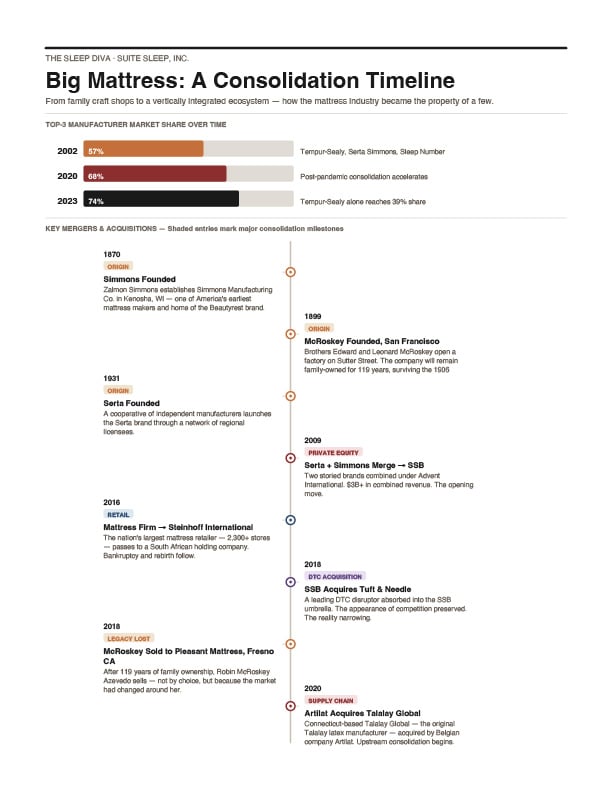
The groundwork was laid quietly. The Simmons brand dates back to 1870 and Serta to 1931; they were ultimately combined under one corporate entity in 2010, backed by private equity firm Advent International. At the time it felt like a business story. In retrospect it was the opening move. Serta Simmons, with roughly $3 billion in revenue, then absorbed Tuft & Needle in 2018, folding one of the most promising direct-to-consumer disruptors into the same corporate umbrella that already controlled two of the industry’s most recognized legacy brands. The appearance of competition was preserved. The reality was narrowing.
Meanwhile, Tempur Sealy was quietly becoming the dominant force in the industry. Its market share rose from 29% in 2016 to 39% by 2023. By 2020, the top three bedding manufacturers — Tempur-Sealy, Serta Simmons, and Sleep Number — controlled 68% of the market, up from 57% in 2002. For an industry that likes to describe itself as highly competitive, those numbers tell a different story.
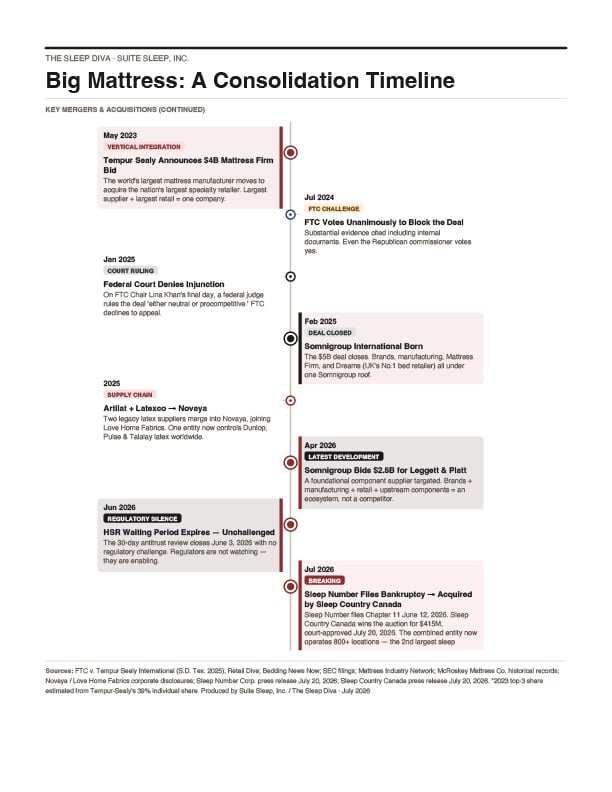
Then came the move that changed everything. In May 2023, Tempur Sealy announced its intention to acquire Mattress Firm, the nation’s largest mattress specialty retailer, operating approximately 2,300 stores across all 50 states. The FTC filed its complaint on July 2, 2024, alleging that the acquisition would combine the largest mattress supplier in the world with the largest mattress retailer in the country, in violation of federal antitrust law. The Commission voted unanimously to challenge the acquisition, with the FTC’s own Republican commissioner citing “substantial evidence,” including internal company documents suggesting the transaction would reduce competition.
The court disagreed. On January 31, 2025 — the final day of FTC Chair Lina Khan’s tenure — a federal judge denied the FTC’s motion for a preliminary injunction, finding the deal “either neutral or procompetitive” and “in the public interest.” The FTC declined to appeal. Five days later, on February 5, 2025, the acquisition closed. Tempur Sealy changed its name to Somnigroup International, with Tempur Sealy, Mattress Firm, and Dreams operating as decentralized business units under one corporate roof.
One company now controlled major bedding brands, significant domestic manufacturing capacity, and the largest specialty mattress retail channel in the country.
The remedial commitment Somnigroup made to the court — reserving at least 25% of Mattress Firm’s total floor space for third-party brands for five years — may sound like a meaningful concession. It isn’t. A company that owns both the factory and the showroom floor has a natural incentive to favor its own products, its own promotions, its own pricing strategy, and its own long-term distribution goals. That doesn’t require a conspiracy. It is simply how incentives work. A five-year promise with self-reported compliance is not a structural remedy — it is a fig leaf.
But the story doesn’t end there. In April 2026, Somnigroup announced a proposed acquisition of Leggett & Platt, one of the bedding industry’s most foundational component suppliers, in a deal valued at approximately $2.5 billion. On June 3, 2026, the required 30-day HSR antitrust waiting period expired without U.S. antitrust regulators moving to challenge the deal.
As this post goes to publication, the consolidation wave claimed another casualty. On July 20, 2026 — today — Sleep Country Canada announced the acquisition of substantially all assets of Sleep Number, the third-largest bedding manufacturer in the United States, following a competitive court-supervised sale process. Sleep Number had filed for Chapter 11 bankruptcy on June 12, 2026, and was acquired for $415 million in cash. The combined entity now operates over 800 retail locations across North America, positioning Sleep Country’s family of brands — which already includes Endy, Silk & Snow, Hush, Casper Canada, and Simba — as the second largest sleep retailer in the world. The “big three” American bedding manufacturers are now effectively two. The speed at which this industry is being reorganized should alarm anyone paying attention.
Consider what that means. One corporate group would have influence across brands, manufacturing, retail distribution, consumer data, and key upstream components. That is not a company competing in a market. That is an ecosystem — and everyone else is living inside it.
WHAT IT COSTS THE REST OF US
As founder of Suite Sleep, I have been manufacturing organic mattresses in Boulder, Colorado for almost 2 decades. I know this industry not from a spreadsheet but from the factory floor, from supplier relationships built over years, and from conversations with manufacturing partners whose names most consumers will never know but whose craft is responsible for some of the finest sleep products made in America.
What I can tell you from that vantage point is this: the squeeze is real, and it is accelerating.

When global supply chains tighten — whether from weather events, shipping disruptions, or raw material shortages — it is not a neutral event for all manufacturers equally. Large vertically integrated companies with captive supply arrangements, long-term contracts, and the purchasing power that comes with scale are insulated in ways that small independent manufacturers simply are not. When supply gets short, the giants get served first. The rest of us wait — and we wait longer, pay more, and are asked to accept terms we would never have agreed to in a stable market. Prepayment requirements that didn’t exist in decade-long supplier relationships. Minimum order quantities that exceed what a boutique manufacturer can reasonably absorb. Lead times that stretch from weeks into months. Price increases passed down the chain with little notice and no negotiation.
These are not complaints. They are market realities. And they are the predictable consequence of an industry where purchasing power has become so concentrated that suppliers rationally prioritize their largest customers — not because they don’t value smaller relationships, but because the economics of consolidation have made that the only sensible choice.
The impact extends beyond individual manufacturers to the factories that serve them. In the past few months I have visited and spoken to many of our manufacturing partners in the US and around the world — companies with significant investments in equipment, skilled workforces, and decades of expertise producing for boutique brands like ours. What I found were factories running far below capacity. Fewer employees than I have ever seen on those floors. An unease that is difficult to describe to someone who hasn’t stood in a quiet factory that used to hum. These are businesses that have made good decisions — invested in quality, built loyal customer relationships, maintained their craft — and are now genuinely uncertain about their future. Not because they made major business mistakes, but because the market around them has been reshaped by forces that have nothing to do with the quality of what they make.
That is the human cost that doesn’t appear in a merger prospectus.

The consolidation isn’t limited to brands and retail floors — it runs straight through the supply chain. Talalay Global, Latexco, and Artilat — once independent, competing latex suppliers familiar to anyone in our industry — have been folded into a single entity called Novaya, which itself became part of Love Home Fabrics, a Belgian conglomerate, in 2023. One company now controls Dunlop, Pulse, and Talalay latex production simultaneously — the three primary latex technologies used in bedding worldwide. For a small organic mattress manufacturer, the narrowing of that supply chain is not an abstraction. It is a phone call telling you your shipment is delayed and that your costs are going up. It is the market making clear that when supply is short, scale determines who gets served first.
WHAT IT COSTS THE CONSUMER
Ultimately, consolidation is a consumer problem — even if consumers don’t know it yet.
When a shopper walks into a mattress store today, they are greeted by a landscape that appears diverse. Different brand names. Different price points. Different aesthetic identities. What is rarely disclosed is how many of those brands share a corporate parent, a manufacturing facility, or a distribution network. The appearance of choice has been carefully maintained. The reality of choice has been quietly eroded.
This is the same experience American banking consumers had in the 1990s, and airline passengers had in the 2000s. In banking, the local branch with the familiar face became an 800-number call center. Checking accounts that were once free began accumulating fees. The neighborhood institution that knew your name and your business became a regional hub managed from a distant corporate office. In airlines, the proliferation of routes and the promise of competition gave way to a market where 87% of domestic passengers were served by just four carriers — and where ancillary fees for baggage, seat selection, and early boarding became a reliable second revenue stream extracted from a captive customer base.
The mattress industry is not there yet. But the trajectory is clear.
When one company controls the brands, the retail floor, and the upstream components, several things become not just possible but predictable. Innovation slows, because the pressure of genuine competition — the kind that comes from a scrappy independent manufacturer with something to prove — is replaced by the more comfortable pace of an industry leader managing its own ecosystem. Transparency diminishes, because there is less incentive to explain sourcing, materials, or manufacturing practices when the consumer has fewer genuine alternatives. Quality pressure eases, because the customer who is dissatisfied has fewer places to go. And prices — insulated from the discipline that real competition provides — find their natural direction upward.
For the conscious consumer who cares about what they are sleeping on — the materials, the sourcing, the people who made it — consolidation poses a particular threat. The organic and specialty sleep market exists precisely because independent manufacturers were willing to do things differently: to source responsibly, to build transparently, to compete on quality rather than marketing spend. That ecosystem depends on a supply chain that remains accessible to small manufacturers, on retail channels that remain open to independent brands, and on consumers who understand that the brand name on the tag and the company that actually controls the product are not always the same thing.
The free market only functions as advertised when the market is actually free. Free markets require genuine competition — not the simulation of it. They require that a small manufacturer in Colorado, or a craft factory in California, or a supplier in a distant country have a fair shot at earning business on the merits of their product. When purchasing power becomes so concentrated that suppliers must prioritize scale over relationships, when retail floors are controlled by the same entity that controls the brands displayed on them, and when antitrust regulators allow the waiting period on a foundational component supplier acquisition to expire without challenge — the market is no longer free in any meaningful sense. It is managed. And the ones managing it are not the consumers, the small manufacturers, or the craft factories. They are the shareholders of a handful of very large companies.
The mattress industry was built by people like the McRoskey brothers — two entrepreneurs who showed up in San Francisco with an idea, found a need, and built something that lasted 125 years. That spirit of independent enterprise is still alive in this industry. It is in the boutique manufacturers, the specialty retailers, the family-owned suppliers, and the small brands that compete on quality and transparency because they have no other choice.
The question is whether the market conditions that allow that spirit to survive are being protected — or quietly dismantled, one acquisition at a time.